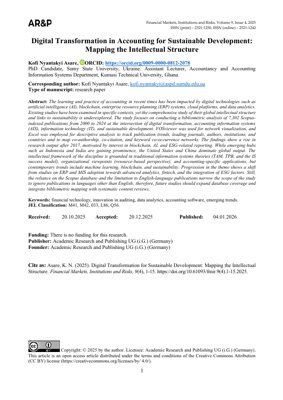
Digital Transformation in Accounting for Sustainable Development: Intellectual Structure Analysis
A bibliometric analysis mapping the intellectual structure of digital transformation in accounting for sustainable development, covering trends, key themes, and future directions.
Home »
Documentation »
Digital Transformation in Accounting for Sustainable Development: Intellectual Structure Analysis
1. Introduction
This research paper presents a bibliometric analysis to map the intellectual structure at the intersection of digital transformation, accounting information systems (AIS), and sustainable development. The study analyzes 7,302 Scopus-indexed publications from 2000 to 2024 to identify trends, key contributors, and thematic evolution.
The core motivation is the profound impact of technologies like Artificial Intelligence (AI), blockchain, ERP systems, and data analytics on accounting practice and its role in enabling sustainable development goals (SDGs). The paper aims to provide a comprehensive, data-driven overview of this evolving field.
2. Methodology & Data
The study employs a rigorous bibliometric methodology to ensure a systematic and reproducible analysis.
2.1 Data Collection
Data was sourced exclusively from the Scopus database, covering publications from 2000 to 2024. The search query combined keywords related to "digital transformation," "accounting," "information systems," and "sustainability." The final dataset comprised 7,302 documents, including articles, conference papers, and reviews.
VOSviewer: Used for network visualization, specifically for creating co-authorship, co-citation, and keyword co-occurrence maps. These visualizations help identify research clusters and intellectual connections.
Microsoft Excel: Employed for descriptive statistical analysis to track publication volume over time, leading journals, authors, institutions, and countries.
3. Results & Findings
3.1 Publication Trends
The analysis reveals a significant inflection point around 2017, with a sharp and sustained increase in publication output. This surge is strongly correlated with rising scholarly and practical interest in blockchain technology, AI applications in auditing and reporting, and the formalization of Environmental, Social, and Governance (ESG) reporting frameworks.
Visualization Note: A line chart would show a relatively flat trend from 2000-2016, followed by a steep, near-exponential growth curve from 2017-2024.
3.2 Leading Contributors
Geographic Dominance: The United States and China are the undisputed leaders in total research output, reflecting their advanced technological ecosystems and large academic bases. However, emerging research hubs in Indonesia and India are gaining notable prominence, indicating a geographical diversification of interest.
Institutional & Author Networks: Co-authorship analysis shows clusters centered around major universities in the US, UK, Australia, and China. The network is moderately connected, with some key authors acting as bridges between different research groups.
3.3 Intellectual Structure & Themes
Keyword co-occurrence and co-citation analysis reveal a multi-layered intellectual structure:
Foundational Theories: The field is grounded in traditional Information Systems theories such as the Technology Acceptance Model (TAM), Theory of Planned Behavior (TPB), and the IS Success Model. Organizational theories like the Resource-Based View (RBV) are also prevalent.
Thematic Evolution: Research has evolved from early focus on ERP and Management Information System (MIS) adoption to contemporary themes like machine learning, predictive analytics, fintech, and the integration of ESG factors into accounting and assurance processes.
Core Technology Clusters: Distinct clusters form around:
AI & Data Analytics: Focus on automation, fraud detection, and predictive forecasting.
Blockchain: Focus on audit trails, transaction integrity, and smart contracts for automated compliance.
Sustainability Reporting: Focus on ESG metrics, integrated reporting, and assurance of non-financial data.
4. Discussion & Analysis: An Industry Analyst's Perspective
4.1 Core Insight
The research landscape is undergoing a fundamental paradigm shift, moving from viewing technology as a mere efficiency tool for accounting to recognizing it as the central nervous system for sustainable value creation and verification. The convergence of AI's analytical power, blockchain's immutable trust, and the imperative of ESG reporting is creating a new, integrated discipline. This isn't just about faster bookkeeping; it's about enabling real-time, assured sustainability intelligence that directly informs capital allocation and corporate strategy.
4.2 Logical Flow
The paper's logic is sound but reveals a field playing catch-up. It starts by observing the technological disruption (AI, blockchain) and the regulatory/societal push (ESG). It then uses bibliometrics to map how academia has responded. The flow shows a lag: practice (driven by fintechs and forward-thinking corporates) is ahead of consolidated academic theory. The intellectual structure is still partially anchored in 1990s IS adoption theories (TAM, TPB), while the cutting edge is in complex systems integrating neural networks for materiality assessment or cryptographic proofs for carbon credit tracing. The logical next step, which the paper hints at, is developing new, hybrid theoretical frameworks that can explain this convergence.
4.3 Strengths & Flaws
Strengths: The scale (7,302 documents) provides undeniable macro-trend credibility. Identifying the 2017 inflection point is crucial—it aligns with the mainstreaming of the TCFD recommendations and the crypto/blockchain boom. Highlighting the rise of Indonesia and India is perceptive, pointing to future growth markets for both research and application.
Critical Flaws: The exclusive reliance on Scopus is a major blind spot. It systematically excludes influential grey literature (consultancy reports from McKinsey, PwC), pre-prints (arXiv, SSRN), and non-English scholarship, potentially missing innovative work from Europe (e.g., German "Industrie 4.0" accounting research) or Japan. The methodology is descriptive, not predictive or prescriptive. It tells us where the field has been, not where it must go. There's a lack of critical engagement with the "greenwashing tech" risk—how these tools can be used to obfuscate rather than clarify sustainability performance.
4.4 Actionable Insights
For Corporate Finance & Accounting Leaders: Move beyond pilot projects. The data shows the trend is irreversible. Invest in integrated platforms that combine financial and ESG data analytics, and prioritize skills in data science and systems thinking for your accounting teams.
For Academics & Journal Editors: Actively solicit research that bridges the identified clusters. Encourage studies that combine blockchain mechanics with behavioral accounting or AI ethics with audit quality. Expand literature reviews beyond Scopus.
For Technology Vendors (SAP, Oracle, Workiva): The research confirms the market demand for convergence. Develop and clearly market "sustainability assurance modules" within your core AIS/ERP offerings, leveraging your embedded AI and data capabilities.
For Regulators & Standard-Setters (IASB, ISSB): The intellectual structure is fragmented. You have a role to play in fostering coherence. Issue guidance or discussion papers on the use of specific technologies (e.g., "principles for the use of blockchain in audit evidence gathering") to steer both practice and research toward robust, standardized applications.
5. Technical Framework & Case Example
Conceptual Framework for Impact Measurement: A key challenge in sustainability accounting is quantifying the causal impact of corporate activities. Drawing inspiration from causal inference methods in machine learning, such as those discussed in the Journal of Causal Inference, a potential framework can be proposed:
The "sustainability outcome" $Y$ (e.g., reduction in local water pollution) is modeled as a function of a corporate intervention $T$ (e.g., new filtration technology), observable confounders $X$ (e.g., plant size, industry, regional rainfall), and an error term $\epsilon$:
$Y_i = \tau T_i + \beta X_i + \epsilon_i$
Where $\tau$ is the Average Treatment Effect (ATE)—the precise, isolated impact of the sustainability intervention. Advanced AIS can be designed to continuously collect high-frequency data on $T$ and potential confounders $X$, allowing for quasi-experimental designs (e.g., Difference-in-Differences, Propensity Score Matching) to estimate $\tau$ more reliably than simple before-after comparisons. This moves sustainability reporting from narrative claims to evidence-based, data-driven impact statements.
Non-Code Case Example: Blockchain for ESG Supply Chain Assurance
Scenario: A multinational apparel company claims its cotton is "100% sustainably sourced."
Traditional AIS Flaw: Relies on manual, periodic certificates from suppliers, prone to fraud, loss, and time-lags.
Integrated Digital Solution:
IoT & ERP: At the farm, IoT sensors record water/fertilizer use, feeding data directly into the farmer's (and eventually the buyer's) ERP system.
Blockchain Layer: Key attestation events (harvest batch certified, shipment received at gin) are hashed and written to a permissioned blockchain. Each event includes a unique digital signature and a link to the source ERP data.
AI Analytics Layer: An AI model continuously analyzes the IoT/ERP data stream against sustainability thresholds (e.g., water usage per kg of cotton).
Integrated Reporting Output: The company's AIS automatically generates a real-time dashboard for managers and a verifiable, tamper-evident report for auditors and consumers. A QR code on a garment's tag links to the immutable blockchain record of that batch's journey.
This framework demonstrates how the intellectual clusters identified in the paper (ERP/data, blockchain, AI, sustainability reporting) converge into a single, auditable workflow.
6. Future Applications & Directions
The trajectory points towards several critical future directions:
AI-Powered Materiality Determination: Moving beyond static checklists, NLP models will analyze news, social media, regulatory filings, and scientific reports to dynamically identify and weight the ESG issues most material to a specific company and its stakeholders, as suggested by research from the MIT Center for Collective Intelligence.
Decentralized Autonomous Organizations (DAOs) and Accounting: As DAOs become more prevalent, entirely new, code-based accounting and audit systems embedded in their smart contract governance will be required, a frontier barely touched by current literature.
Integration with Physical Sensors (Digital Twins): Accounting systems will be fed real-time data from digital twins of factories, supply chains, and even natural capital (forests, watersheds), enabling continuous environmental cost accounting and depletion accounting.
Explainable AI (XAI) for Audit Trails: The "black box" problem of complex AI models is a major audit barrier. Future research must focus on developing and standardizing XAI techniques that provide human-interpretable rationale for AI-driven accounting judgments, crucial for meeting audit standards.
Interoperability Protocols: The true power will be unlocked not by single systems, but by secure protocols that allow different organizations' AIS, blockchain networks, and ESG data platforms to communicate seamlessly, creating a trusted web of sustainability information.
7. References
Asare, K. N. (2025). Digital Transformation in Accounting for Sustainable Development: Mapping the Intellectual Structure. Financial Markets, Institutions and Risks, 9(4), 1-15.
Davis, F. D. (1989). Perceived Usefulness, Perceived Ease of Use, and User Acceptance of Information Technology. MIS Quarterly, 13(3), 319-340. (TAM Theory)
DeLone, W. H., & McLean, E. R. (2003). The DeLone and McLean Model of Information Systems Success: A Ten-Year Update. Journal of Management Information Systems, 19(4), 9-30.
International Financial Reporting Standards (IFRS) Foundation. (2023). ISSB Standards IFRS S1 and S2. Retrieved from https://www.ifrs.org
Pearl, J., & Mackenzie, D. (2018). The Book of Why: The New Science of Cause and Effect. Basic Books. (Causal Inference)
World Economic Forum. (2020). Digital Transformation of Industries: Sustainability. Retrieved from https://www.weforum.org
Zhu, J., et al. (2017). Unpaired Image-to-Image Translation using Cycle-Consistent Adversarial Networks. Proceedings of the IEEE International Conference on Computer Vision (ICCV). (CycleGAN as an example of generative AI relevant for synthetic data generation in audit testing).