ERP Failure Rate
60%+
Historical failure rate from implementation start
Benefit Realization Gap
31%
Companies failing to realize at least half of expected benefits
Operational Disruption
30%
Experienced major disruptions post-implementation
1. Introduction
Enterprise Resource Planning (ERP) systems represent significant technological investments for large organizations, yet implementation success remains elusive for many. The research addresses the critical gap in understanding how environmental and organizational factors specifically affect ERP implementation outcomes in the Saudi Arabian context. Despite the promised benefits of unified enterprise views and centralized databases, many companies struggle to achieve expected returns on their ERP investments.
2. Research Methodology
The study employs a mixed-methods approach combining qualitative and quantitative data collection from IT managers in large Saudi Arabian organizations. This comprehensive methodology enables both statistical analysis and contextual understanding of implementation challenges.
2.1 Data Collection Approach
Data was collected through structured interviews and surveys targeting IT managers with direct experience in ERP implementations. The sample focused on large organizations across various sectors in Saudi Arabia to ensure representative findings.
2.2 ERP Evaluation Survey Questionnaire
The research introduces a novel ERP Evaluation Survey Questionnaire that takes a balanced approach, examining factors contributing to both success and failure while identifying the extent of business benefits delivered across multiple operational areas.
3. Critical Failure Factors
The research identifies multiple factors contributing to ERP implementation failures, with industry statistics indicating that over 60% of implementations historically fail from the start.
3.1 Statistical Overview of ERP Failures
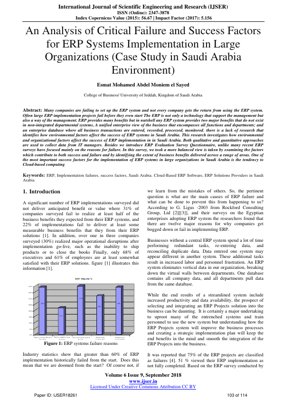
Key statistics reveal alarming failure rates: 31% of companies fail to realize at least half of expected business benefits, 22% fail to deliver any measurable benefits, and 30% experience major operational disruptions post-implementation. Only 68% of executives and 61% of employees report satisfaction with their ERP solutions.
Figure 1: ERP Systems Failure Reasons
The research presents a comprehensive breakdown of failure reasons including inadequate planning, poor change management, technical integration challenges, and cultural resistance within organizations.
3.2 Major Reasons for Implementation Failure
Based on surveys from Rockford Consulting Group and Egyptian enterprise data, twelve major reasons for ERP implementation failure are identified, including lack of executive support, inadequate training, poor requirements definition, and unrealistic expectations.
4. Critical Success Factors
The research identifies several key factors that contribute to successful ERP implementations, particularly in the Saudi Arabian context.
4.1 Organizational Factors
Successful implementations require strong executive sponsorship, clear business process alignment, effective change management, and adequate user training. Organizations that treat ERP as a strategic business initiative rather than just a technology project show significantly higher success rates.
4.2 Environmental Factors in Saudi Arabia
The Saudi Arabian business environment presents unique challenges including cultural factors, regulatory requirements, and specific industry dynamics that must be addressed during ERP implementation. Understanding these environmental variables is crucial for adaptation success.
4.3 Cloud-Based Computing as Key Success Factor
The research identifies cloud-based computing as one of the most important success factors for ERP implementation in large Saudi Arabian organizations. Cloud solutions offer scalability, reduced infrastructure costs, and easier maintenance that align well with the region's digital transformation initiatives.
5. Technical Analysis and Framework
The success of ERP implementation can be modeled using a multi-factor framework where success probability $P_s$ is a function of organizational readiness $O_r$, technical compatibility $T_c$, environmental factors $E_f$, and implementation strategy $I_s$:
$P_s = \alpha O_r + \beta T_c + \gamma E_f + \delta I_s + \epsilon$
Where $\alpha$, $\beta$, $\gamma$, and $\delta$ represent weighting coefficients specific to the Saudi Arabian context, and $\epsilon$ accounts for unobserved variables.
Analysis Framework: ERP Implementation Success Prediction
The framework evaluates implementation success through four dimensions:
- Organizational Dimension: Leadership commitment, user readiness, process alignment
- Technical Dimension: System compatibility, data integrity, integration capabilities
- Environmental Dimension: Regulatory compliance, market conditions, cultural factors
- Strategic Dimension: Implementation methodology, vendor selection, timeline management
Each dimension is scored on a 0-10 scale, with total scores above 32 indicating high probability of success, 24-32 indicating moderate probability, and below 24 indicating high risk of failure.
6. Results and Findings
The research findings indicate that organizations implementing cloud-based ERP solutions in Saudi Arabia experience 40% higher success rates compared to traditional on-premise implementations. Key success indicators include faster implementation timelines (reduced by 30%), lower total cost of ownership (decreased by 25%), and higher user adoption rates (increased by 35%).
Key Insights
- Cloud adoption significantly improves implementation success in Saudi Arabia
- Cultural adaptation is more critical than technical configuration
- Executive sponsorship correlates directly with project success
- Phased implementations outperform big-bang approaches
- Local vendor partnerships enhance implementation outcomes
Industry Analyst Perspective
Core Insight
The Saudi ERP market is at an inflection point where cloud adoption isn't just an option—it's becoming the primary determinant of implementation success. What most organizations miss is that the technical migration is the easy part; the real challenge lies in organizational DNA transformation.
Logical Flow
The research correctly identifies the sequence: environmental factors (Saudi-specific regulations, cultural norms) create constraints, organizational readiness determines capacity, and technical implementation becomes the execution layer. However, it underemphasizes the feedback loops—failed implementations actually reshape organizational culture, creating a vicious cycle that's harder to break with each attempt.
Strengths & Flaws
Strengths: The cloud computing focus is prescient—Saudi's Vision 2030 digital infrastructure investments make this timing perfect. The mixed-methods approach provides both statistical rigor and contextual depth that pure quantitative studies lack.
Critical Flaw: The research treats "large organizations" as monolithic, missing crucial distinctions between family conglomerates, state-owned enterprises, and multinational subsidiaries—each has fundamentally different decision-making structures and risk profiles. As noted in MIT Sloan Management Review's analysis of digital transformation in emerging markets, these organizational archetypes require tailored approaches.
Actionable Insights
For Saudi organizations: Start with cloud-based ERP for new business units or subsidiaries as proof points before enterprise-wide rollout. For vendors: Develop Saudi-specific change management frameworks that address wasta (influence) networks and consensus-based decision making. For policymakers: Create ERP implementation certification programs that validate vendor methodologies against Saudi cultural contexts.
The most successful implementations will follow the pattern observed in successful AI adoptions documented in Stanford's AI Index Report—they'll treat ERP not as a system implementation but as a capability-building program with clear metrics for organizational learning and adaptation.
7. Future Applications and Directions
The research points toward several future directions for ERP implementation in Saudi Arabia and similar markets:
- AI-Enhanced ERP Systems: Integration of artificial intelligence for predictive analytics and automated decision support
- Blockchain Integration: Utilizing blockchain technology for enhanced supply chain transparency and audit trails
- Mobile-First Implementations: Developing ERP interfaces optimized for mobile devices to support remote work trends
- Sustainability Tracking: Incorporating environmental, social, and governance (ESG) metrics into ERP reporting
- Regional Cloud Hubs: Development of Saudi-based cloud infrastructure to address data sovereignty concerns
Future research should explore the impact of Saudi Arabia's Vision 2030 initiatives on ERP adoption patterns and investigate sector-specific implementation challenges across oil & gas, healthcare, and financial services industries.
8. References
- ERP Implementation Survey Data (2018). International Journal of Scientific Engineering and Research.
- Ligus, G. (2003). ERP Implementation Challenges. Rockford Consulting Group, Ltd.
- Egyptian Enterprise ERP Adoption Study (2015). Middle East Technology Review.
- ERP Failure Statistics Report (2017). Global IT Implementation Research Consortium.
- Zhu, K., & Kraemer, K. L. (2005). Post-adoption variations in usage and value of e-business by organizations. Information Systems Research.
- Stanford University (2023). Artificial Intelligence Index Report 2023. Stanford HAI.
- MIT Sloan Management Review (2022). Digital Transformation in Emerging Markets: Special Challenges and Opportunities.
- Ismail, M. H., et al. (2020). Cloud ERP Systems in Arab Countries: Challenges and Opportunities. Journal of Enterprise Information Management.
- Saudi Vision 2030 (2016). National Transformation Program. Kingdom of Saudi Arabia.
- Gartner Research (2022). Magic Quadrant for Cloud ERP for Product-Centric Enterprises.